
“Human Factors and Ergonomics in Health and Social Care: An Applied Approach.”
Sujan, Pickup, Vosper and Catchpole
Review by Dr Dawn Benson
February 2026
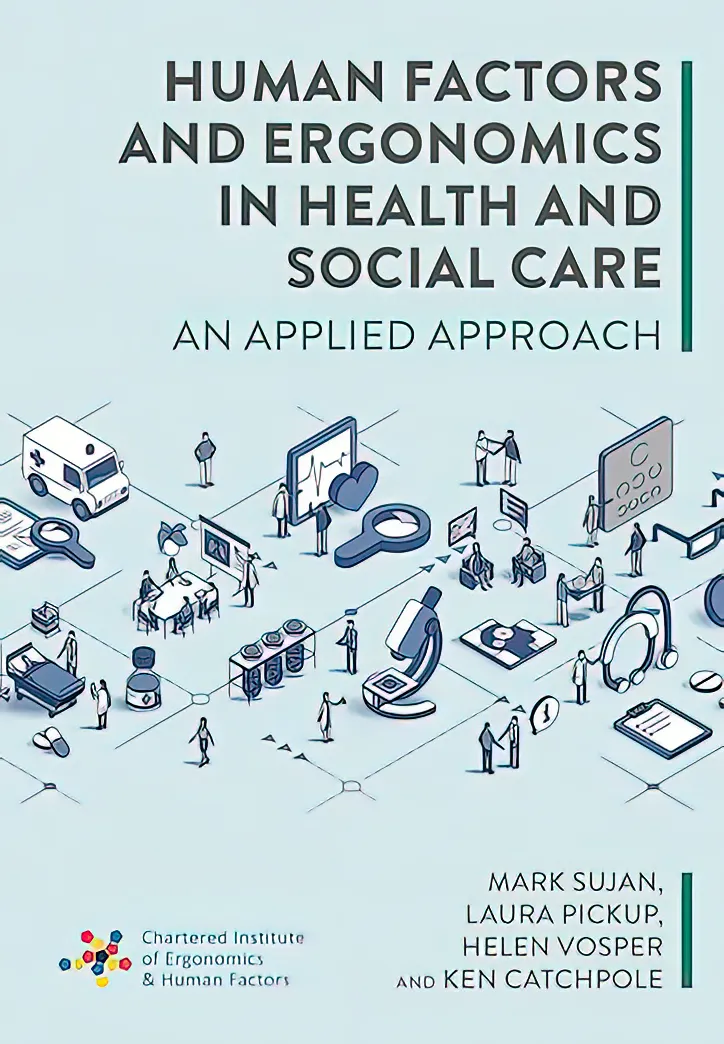
Reading Human Factors and Ergonomics in Health and Social Care: An Applied Approach was, for me, a quietly reassuring experience. It articulated – clearly, carefully, and without hype – what many of us have been working towards for years. The authors are people I know, people I work with, and people whose thinking has shaped my own practice. Seeing that collective experience set down so coherently felt less like reading a textbook and more like standing on solid ground.
What this book does particularly well is resist the temptation to oversimplify. Human factors in health and social care is often either over-theorised or reduced to a handful of buzzwords. This text avoids both traps. It takes a systems view seriously, not as an abstract ideal but as something that has practical consequences for how work is designed, how decisions are made, and how responsibility is understood. The use of SEIPS as a recurring structure gives the book a clarity and consistency that makes it easy to navigate without flattening the complexity of real-world practice.
There is a strong sense throughout that this book has been written by people who have spent a lot of time in the messiness of healthcare: watching workarounds emerge, seeing how policies collide with reality, and understanding why “doing the right thing” is often harder than it looks on paper. The chapters on tasks, teamwork, environment, and organisational learning in particular reflect a deep respect for the adaptive work that staff do every day. This is not a book that blames individuals or reaches for simple fixes. Instead, it repeatedly brings the focus back to how systems shape behaviour, and how better design can make safe, effective work easier rather than heroic.
Importantly, while many of the ideas will be familiar to experienced HF/E practitioners, the book does not feel like an echo chamber. There is a discipline to how concepts are explained, linked to competencies, and grounded in applied examples. The alignment with the CIEHF Healthcare Learning Pathway is handled thoughtfully, making the book useful both as a learning resource and as a reference for more established practitioners. It invites reflection rather than agreement, and it leaves space for readers to locate their own context within the frameworks it presents.
I also appreciated the attention given to equality, diversity and inclusion, and to integration rather than bolt-on approaches to human factors. These chapters feel timely and necessary, not tokenistic. They reinforce the central message of the book: that human factors is not an intervention you apply after something goes wrong, but a way of thinking about how systems are designed, led, and sustained.
Overall, this is a generous and grounded contribution to the field. It doesn’t shout, and it doesn’t promise miracles. Instead, it offers something more valuable: a shared language, a coherent structure, and a sense that the work many of us are doing – often in difficult conditions – is intellectually sound and worth continuing. For me, that reassurance mattered.