My Investigation Toolkit #2: The Terms of Reference and Key Lines of Enquiry.
Knowing Where You Are Going and How You Will Get There
Dr Dawn Benson
Every year I donate time to my local NHS Trusts. This year I have been working closely with one to support key staff in developing their investigation skills. Last week I did my usual check in and asked them if there was anything they would like to cover in the future. Someone said key lines of enquiry (KLE). It was a good answer. It told me the group were ready to go deeper.
Years of teaching research methods has taught me that being anchored to what you are trying to achieve is critical. But before we can talk about KLE we need to talk about terms of reference (ToRs), because you cannot understand one without the other. I have worked with investigators who conflate the two, to their peril.
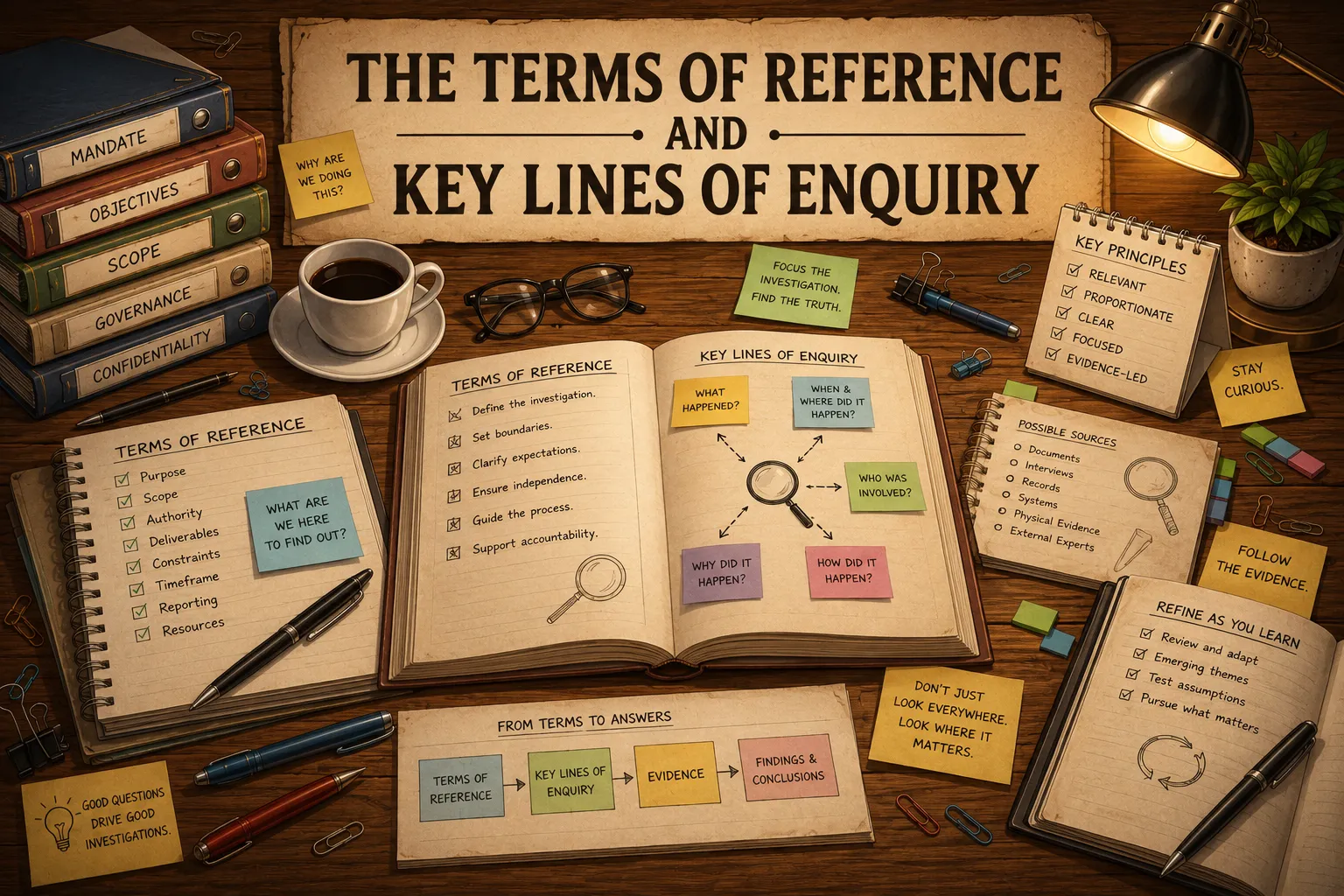
The ToRs are the destination. They set out what is being investigated, why, over what time period, who commissioned the investigation, and what it is expected to deliver. They do not tell you what you will find when you get there. They ensure that everyone starts the journey with a shared understanding of where they are headed. The KLE are the itinerary. The specific areas you will explore, the questions you will pursue, the evidence you will gather. Together they work in sequence. Without a destination the itinerary is meaningless. Without an itinerary the destination remains out of reach.
Setting good KLE is harder than it looks. Write them too broadly and the enquiry loses direction. Write them too narrowly and you close off the very lines of evidence the investigation most needs to follow. They need to be strong enough to contain the investigation whilst flexible enough to move with the direction the evidence is moving in. They will be neither vague nor dogmatic.
Setting them also fundamentally requires the investigator to be inclusive. I was recently investigated a Trusts investigation. I listened to the family, the Trust and the staff before drafting the KLE. After sharing them we changed only one word. That told me the process had worked. The KLE belonged to everyone because everyone had helped to shape them.
Throughout that investigation I used the ToRs and KLE as live tools. They were a constant reference point for evidence collection, analysis, and to guide every decision about where the investigation needed to go next. Toward the end the Trust challenged my request to interviewing someone. I reflected – the KLE told me that conversation was not necessary. When I explained that to the family, using the KLE to show them the reasoning, they were satisfied. They trusted it because they had helped build it.
That is what good KLE make possible. Not just a structured investigation. A transparent one.
Who is the investigation for?
Who is the investigation for? The legal and policy framework is unambiguous on this point. The investigation is for the patient and family. Other parties have an interest. The coroner, the CQC, regulators, HR, the executive. Some have legal rights of access to documents. But having the right to see something is not the same as being the person it was written for.
In practice this distinction is frequently lost. Reports are drafted with one eye on the regulator or the coroner. The language becomes institutional. The framing becomes defensive. And the family receive a document that was never really written for them at all. If the KLE are set with the family from the beginning that cannot happen.
Five Tips
- Visit the family before you write a single word of the KLE. Hear their story first. Their questions are not supplementary to the investigation. They are its foundation.
- Frame every KLE as an open question. Not ‘why did this happen?’ but ‘what factors contributed?’. It is the difference between an investigation that confirms and one that discovers.
- Treat the ToRs and KLE as live documents not an opening formality. I return to mine throughout. They keep me honest and when the evidence takes me somewhere the original framing did not anticipate I review them. Changing them is not a failure of planning. It is good investigation.
- Use the KLE to make decisions about what evidence you do and do not need. They are not just a map of where to go. They are a principled reason for not going somewhere.
- Share the KLE with everyone from the beginning. If they belong to everyone the investigation belongs to everyone. The family are not an audience at the end of the process. They are present throughout it. And the report that answers their questions was always theirs.
I would strongly recommend reading When the Dust Settles: Stories of Love, Loss and Hope from an Expert in Disaster by Lucy Easthope, published by Hodder and Stoughton in 2022. Nobody writing today makes a more powerful case for what it means to place those affected at the centre of any response to tragedy. It will change how you think about who you are doing this work for.